Apple iPhone 14 Plus
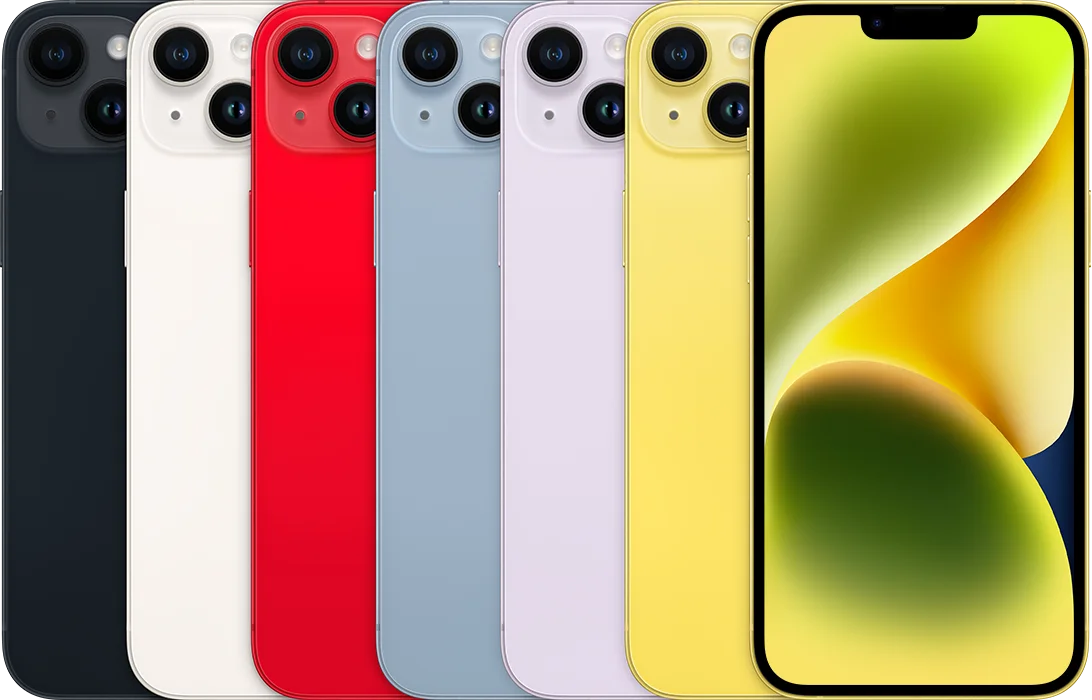
The iPhone 14 Plus is the 6.7-inch big-screen base iPhone that Apple introduced in 2022 in place of the mini. It shares the iPhone 14’s A15 Bionic with a five-core GPU, dual 12 MP cameras and emergency messaging via satellite; the differences are the larger display and longer battery life. The display stays at 60 Hz and charging is through Lightning. In testing, battery life stood out as its main strength.
iPhone 14 Plus (2022); 128, 256 and 512 GB. Models sold in the UK and Europe use nano-SIM and eSIM; the US model A2632 is eSIM-only and supports mmWave 5G. The 6.1-inch iPhone 14 and the 6.7-inch iPhone 14 Pro Max are separate models.
Specifications
| Specification | Value |
|---|---|
| Display | 6.7-inch Super Retina XDR OLED; 2778 × 1284 pixels, 458 ppi; HDR, True Tone, wide colour (P3) |
| Build | Ceramic Shield front, glass back and aluminium frame |
| Water and dust resistance | IP68 (IEC 60529; maximum depth of 6 metres for up to 30 minutes) |
| Chip | A15 Bionic: 6-core CPU (2 performance + 4 efficiency), 5-core GPU, 16-core Neural Engine |
| Storage | 128 GB, 256 GB or 512 GB |
| Rear cameras | 12 MP Main (26 mm, ƒ/1.5, sensor-shift optical image stabilisation, 100% Focus Pixels) and 12 MP Ultra Wide (13 mm, ƒ/2.4, 120°); 2x optical zoom out, digital zoom up to 5x |
| Video | 4K Dolby Vision HDR at 24/25/30/60 fps; Cinematic mode up to 4K HDR at 30 fps; Action mode up to 2.8K at 60 fps; 1080p slo-mo at 120/240 fps |
| Front camera and Face ID | 12 MP TrueDepth, ƒ/1.9, autofocus with Focus Pixels; Face ID |
| Cellular and wireless | 5G (sub-6 GHz; mmWave as well on the US model), Gigabit LTE with 4x4 MIMO, Wi‑Fi 6 (802.11ax) with 2x2 MIMO, Bluetooth 5.3, Ultra Wideband chip, NFC with reader mode |
| SIM | Models sold outside the US: nano-SIM + eSIM or dual eSIM; US: dual eSIM only (no physical SIM support) |
| Satellite and safety features | Emergency SOS via satellite, Crash Detection, Roadside Assistance via satellite |
| Location | GPS, GLONASS, Galileo, QZSS and BeiDou; digital compass; iBeacon |
| Battery and charging | Up to 26 hours of video (20 hours streamed), up to 100 hours of audio; built-in lithium-ion battery; 15 W MagSafe and 7.5 W Qi wireless charging; about 50% in around 30 minutes with a 20 W or higher adapter |
| Port and video output | Lightning; up to 1080p video through the Lightning Digital AV Adapter; up to 4K HDR over AirPlay |
| Audio and video formats | AAC, MP3, Apple Lossless, FLAC, Dolby Digital, Dolby Digital Plus and Dolby Atmos; Spatial Audio; Dolby Vision, HDR10+/HDR10 and HLG for video playback |
| Sensors | Face ID, barometer, high dynamic range gyro, high-g accelerometer, proximity sensor, dual ambient light sensors |
| Size and weight | 160.8 × 78.1 × 7.80 mm; 203 g |
From the manufacturer
Apple presents the iPhone 14 Plus with its 6.7-inch display and what it called the best battery life on an iPhone up to that point. Apple Support
Strengths and limitations
Engadget found that after a first day of setup, benchmarks, video and gaming over about a week of use the iPhone 14 Plus still had more than 45% battery left, and it lost only 1–2% overnight; in the video rundown test it lasted 21 hours 17 minutes. With a light meter the screen reached just under 825 nits. The 60 Hz panel looked less smooth than 120 Hz screens in fast motion, the camera sometimes overexposed daytime shots, and at night it captured slightly less detail than the Pixel 6 Pro.
Engadget: Apple iPhone 14 Plus reviewIn Laptop Mag’s five-month long-term review the phone lasted 11 hours 57 minutes in its continuous web-surfing test at 150 nits over cellular (iPhone 14: 9 hours 1 minute) and reached 46% after 30 minutes of charging. Measured peak brightness was 764 nits and the reviewer struggled to read the screen in bright sun; DCI-P3 coverage measured 85%. The speakers played without distortion at full volume, and there was no slowdown with many tabs and apps open. The body was noted for resisting fingerprints.
Laptop Mag: iPhone 14 Plus long-term review
Tags
Compare
- OPPO Find X10 Pro Max / Apple iPhone 14 Plus
- Apple iPhone 18 Pro / Apple iPhone 14 Plus
- Samsung Galaxy S26 FE / Apple iPhone 14 Plus
- Google Pixel 11 Pro / Apple iPhone 14 Plus
- Apple iPhone 17e / Apple iPhone 14 Plus
- Samsung Galaxy S26 / Apple iPhone 14 Plus
- Google Pixel 11 / Apple iPhone 14 Plus
- Google Pixel 11 Pro XL / Apple iPhone 14 Plus
- Motorola razr 70 ultra / Apple iPhone 14 Plus
- Samsung Galaxy S26 Ultra / Apple iPhone 14 Plus
- Samsung Galaxy S26+ / Apple iPhone 14 Plus
- Samsung Galaxy Z Flip8 / Apple iPhone 14 Plus
- Samsung Galaxy Z Fold8 / Apple iPhone 14 Plus
- Sony Xperia 1 VIII / Apple iPhone 14 Plus
- vivo X500 / Apple iPhone 14 Plus
- Xiaomi 17T / Apple iPhone 14 Plus
- Apple iPhone 17 Pro / Apple iPhone 14 Plus
- Google Pixel 10 Pro / Apple iPhone 14 Plus
- Google Pixel 10 Pro XL / Apple iPhone 14 Plus
- Samsung Galaxy Z Flip7 / Apple iPhone 14 Plus
- Samsung Galaxy Z Fold7 / Apple iPhone 14 Plus
- Samsung Galaxy S25 Edge / Apple iPhone 14 Plus
- Google Pixel 9a / Apple iPhone 14 Plus
- Samsung Galaxy A36 5G / Apple iPhone 14 Plus
- Samsung Galaxy S25 Ultra / Apple iPhone 14 Plus
- Samsung Galaxy S25 / Apple iPhone 14 Plus
- Apple iPhone 16e / Apple iPhone 14 Plus
- Apple iPhone 17 / Apple iPhone 14 Plus
- Apple iPhone 17 Pro Max / Apple iPhone 14 Plus
- Apple iPhone Air / Apple iPhone 14 Plus
- Google Pixel 10 / Apple iPhone 14 Plus
- Samsung Galaxy A56 5G (SM-A566B) / Apple iPhone 14 Plus
- Samsung Galaxy S25+ / Apple iPhone 14 Plus
- Apple iPhone 16 / Apple iPhone 14 Plus
- Apple iPhone 16 Pro / Apple iPhone 14 Plus
- Apple iPhone 16 Pro Max / Apple iPhone 14 Plus
- Google Pixel 9 / Apple iPhone 14 Plus
- Samsung Galaxy Z Flip6 / Apple iPhone 14 Plus
- Samsung Galaxy Z Fold6 / Apple iPhone 14 Plus
- Samsung Galaxy S24 (SM-S921B) / Apple iPhone 14 Plus
- Samsung Galaxy S24 Ultra / Apple iPhone 14 Plus
- Google Pixel 8 / Apple iPhone 14 Plus
- Apple iPhone 15 Plus / Apple iPhone 14 Plus
- Apple iPhone 15 Pro / Apple iPhone 14 Plus
- Apple iPhone 15 Pro Max / Apple iPhone 14 Plus
- Samsung Galaxy A54 5G / Apple iPhone 14 Plus
- Samsung Galaxy S23 / Apple iPhone 14 Plus
- Samsung Galaxy S23 Ultra / Apple iPhone 14 Plus
- Samsung Galaxy S23+ (SM-S916B) / Apple iPhone 14 Plus
- Apple iPhone 15 / Apple iPhone 14 Plus
- Samsung Galaxy Z Flip5 / Apple iPhone 14 Plus
- Samsung Galaxy Z Fold5 / Apple iPhone 14 Plus
- Apple iPhone 14 / Apple iPhone 14 Plus
- Apple iPhone 14 Plus / Apple iPhone 14 Pro
- Apple iPhone 14 Plus / Samsung Galaxy S22
- Apple iPhone 14 Plus / Apple iPhone 13
- Apple iPhone 14 Plus / Apple iPhone 13 mini